Artificial Intelligence A Lasting Change or Just a Fad?
By Raymond Girbes -
Mar 19, 2026
- 17 minutes read

AI in 2026: Lasting Change or Just a Fad?
The honest answer to whether AI is here to stay or just a fad? It's both!
There's no need to argue that AI is real. It's everywhere you look. It's not a fabrication, it's very much here.
People often ask me for my opinion on AI. So, I thought it was about time I delved deeper.
AI is here to stay
It's a serious technology that is already extremely capable. In key areas, AI is both enduring and practical.
Why is AI enduring?
AI can demonstrably support people in their work, and this effect is here to stay. It accelerates processes, lowers barriers and makes certain tasks cheaper and faster. While this may be unsettling for some, roles involving repetitive tasks or routine analysis, such as those of middle managers, copywriters and data analysts, may largely disappear. Some of these roles will become redundant as AI systems perform these tasks more quickly and consistently. I'll explore this further in the chapter, "The Future of Work: How AI Will Change Your Job".
AI is a fad
Some people create unrealistic expectations, which are often rooted in wishful thinking.
Why is AI a fad?
Even reputable and intelligent people, as well as the mainstream media, can sometimes make critical errors in judgement. There is a common assumption that AI will surpass human intelligence and become a kind of superbrain with a superior understanding.
But is that really the case?
If that were the case, why haven't advanced alien civilisations partnered with AI? Shouldn't we be communicating with futuristic robots by now? Yet that's not happening! Aliens possess remarkable abilities such as anti-gravity, long lifespans and telepathic communication, with no need for speech. Am I impressed? Slightly. Curious? Absolutely.
Aliens
I have no doubt that aliens exist, and I'm not alone in this belief: many high-ranking military officials agree with me. There's so much evidence that you can't ignore it, though perhaps you can with mere opinions, but not with facts. Perhaps that's why Elon Musk claims he hasn't seen any aliens or UAPs. Admitting otherwise would undermine his arguments about AI and superintelligence.
I find Musk exceptionally interesting and intelligent. Let me be clear. I wish him all the best and I admire his accomplishments. However, he has been wrong before, particularly with regard to predictions and deadlines.
Alpha vs. Beta Profiles
Current AI resembles what you might call alpha strengths: excelling at learning, recognition, memory, and reproduction. With enough examples, it can work wonders. Knowing numerous questions and answers makes providing good responses easy, even for the toughest university exams. When intelligence is assessed in this way, AI's IQ appears high. Yet based on such flawed conclusions, billions are being invested in AI today. Visible side effects include surging demand for computing power, putting pressure on energy grids and strongly influencing the memory chip and data centre capacity markets. Consequently, prices for RAM, SSDs, NVMe and eMMC are soaring.
Alpha Intelligence is not the same as understanding
A different picture emerges when you evaluate AI by beta qualities. A beta profile is primarily concerned with understanding and facts. It's less about 'learning as fast as possible', focusing instead on grasping structure and understanding boundaries. Technical and mathematical insight are also part of this. AI is often overestimated in this respect, appearing to be more intelligent than it truly is. A computer that 'knows' a formula can apply it infinitely. This is impressive, but essentially not magical, resembling advanced automation or 'scripting'. It's an old concept, though now on a grander scale with far wider applicability.
People often ask me for my opinion on AI. So, I thought it was about time I delved deeper.
AI is here to stay
It's a serious technology that is already extremely capable. In key areas, AI is both enduring and practical.
Why is AI enduring?
AI can demonstrably support people in their work, and this effect is here to stay. It accelerates processes, lowers barriers and makes certain tasks cheaper and faster. While this may be unsettling for some, roles involving repetitive tasks or routine analysis, such as those of middle managers, copywriters and data analysts, may largely disappear. Some of these roles will become redundant as AI systems perform these tasks more quickly and consistently. I'll explore this further in the chapter, "The Future of Work: How AI Will Change Your Job".
AI is a fad
Some people create unrealistic expectations, which are often rooted in wishful thinking.
Why is AI a fad?
Even reputable and intelligent people, as well as the mainstream media, can sometimes make critical errors in judgement. There is a common assumption that AI will surpass human intelligence and become a kind of superbrain with a superior understanding.
But is that really the case?
If that were the case, why haven't advanced alien civilisations partnered with AI? Shouldn't we be communicating with futuristic robots by now? Yet that's not happening! Aliens possess remarkable abilities such as anti-gravity, long lifespans and telepathic communication, with no need for speech. Am I impressed? Slightly. Curious? Absolutely.
Aliens
I have no doubt that aliens exist, and I'm not alone in this belief: many high-ranking military officials agree with me. There's so much evidence that you can't ignore it, though perhaps you can with mere opinions, but not with facts. Perhaps that's why Elon Musk claims he hasn't seen any aliens or UAPs. Admitting otherwise would undermine his arguments about AI and superintelligence.
I find Musk exceptionally interesting and intelligent. Let me be clear. I wish him all the best and I admire his accomplishments. However, he has been wrong before, particularly with regard to predictions and deadlines.
Alpha vs. Beta Profiles
Current AI resembles what you might call alpha strengths: excelling at learning, recognition, memory, and reproduction. With enough examples, it can work wonders. Knowing numerous questions and answers makes providing good responses easy, even for the toughest university exams. When intelligence is assessed in this way, AI's IQ appears high. Yet based on such flawed conclusions, billions are being invested in AI today. Visible side effects include surging demand for computing power, putting pressure on energy grids and strongly influencing the memory chip and data centre capacity markets. Consequently, prices for RAM, SSDs, NVMe and eMMC are soaring.
Alpha Intelligence is not the same as understanding
A different picture emerges when you evaluate AI by beta qualities. A beta profile is primarily concerned with understanding and facts. It's less about 'learning as fast as possible', focusing instead on grasping structure and understanding boundaries. Technical and mathematical insight are also part of this. AI is often overestimated in this respect, appearing to be more intelligent than it truly is. A computer that 'knows' a formula can apply it infinitely. This is impressive, but essentially not magical, resembling advanced automation or 'scripting'. It's an old concept, though now on a grander scale with far wider applicability.

The AI leaders in 2024, 2025, and 2026. Elon Musk, Jensen Huang, Sundar Pichai, and Sam Altman. Photo illustration: © Xootle B.V.
Are People Like Elon Musk and Sam Altman Mistaken?
Yes, they're mistaken on several points!
A combination of ideology, ambition and excessive business interests can result in inaccurate AI assessments. This applies to almost anyone promoting a significant narrative, particularly when substantial investments are at risk.
My stance is clear and verifiable: true human-like intelligence is impossible with current models (LLMs or their variants). Furthermore, the hype surrounding 'superintelligence' largely rests on misguided interpretations of what these systems can truly do.
A system with an IQ of 70 doesn't produce an IQ of 200!
When it comes to comparing AI with IQ, it excels in pattern recognition, statistical correlations and reproduction, but it cannot independently leap to fundamental autonomous thought. Mathematically speaking, a model that relies solely on training with existing data cannot generate a new form of intelligence. It can optimise and combine, but it cannot simply 'invent' an entirely different understanding. Even if billions are invested in AI, human understanding does not progress; only the speed and scope of intelligence change.
Still, that's largely what fuels the superintelligence hype!
As an outsider with no vested interests in AI companies, no shares and no reputation to defend towards shareholders, I am in a unique position. Most AI leaders cannot make the same claim. Their perceived strength has become their weakness. While I admire their technical progress and accomplishments, I dislike the way their flawed arguments and conclusions hold the world captive. It's simply unnecessary.
Some Examples
Take Musk's self-driving cars, for example: they are an impressive technical feat. Although different approaches are used, fundamentally, it involves advanced pattern recognition using vast amounts of data.
Self-driving is technique, not 'understanding'
Many in the media only see the outcome: a car that drives itself and is labelled intelligent. This says more about word choice and journalistic perspective than it does about the system itself. Nevertheless, many people accept media portrayals. Self-driving systems do not comprehend traffic in the same way as humans do. It operates using enormous amounts of driving data, including video footage, sensor inputs, situations and corresponding decisions. This builds a model proficient in:
This isn't 'understanding', but rather large-scale data processing, rigorous engineering and optimised software. It's impressive, but it's still just technique, not intelligence.
My stance is clear and verifiable: true human-like intelligence is impossible with current models (LLMs or their variants). Furthermore, the hype surrounding 'superintelligence' largely rests on misguided interpretations of what these systems can truly do.
A system with an IQ of 70 doesn't produce an IQ of 200!
When it comes to comparing AI with IQ, it excels in pattern recognition, statistical correlations and reproduction, but it cannot independently leap to fundamental autonomous thought. Mathematically speaking, a model that relies solely on training with existing data cannot generate a new form of intelligence. It can optimise and combine, but it cannot simply 'invent' an entirely different understanding. Even if billions are invested in AI, human understanding does not progress; only the speed and scope of intelligence change.
Still, that's largely what fuels the superintelligence hype!
As an outsider with no vested interests in AI companies, no shares and no reputation to defend towards shareholders, I am in a unique position. Most AI leaders cannot make the same claim. Their perceived strength has become their weakness. While I admire their technical progress and accomplishments, I dislike the way their flawed arguments and conclusions hold the world captive. It's simply unnecessary.
Some Examples
Take Musk's self-driving cars, for example: they are an impressive technical feat. Although different approaches are used, fundamentally, it involves advanced pattern recognition using vast amounts of data.
Self-driving is technique, not 'understanding'
Many in the media only see the outcome: a car that drives itself and is labelled intelligent. This says more about word choice and journalistic perspective than it does about the system itself. Nevertheless, many people accept media portrayals. Self-driving systems do not comprehend traffic in the same way as humans do. It operates using enormous amounts of driving data, including video footage, sensor inputs, situations and corresponding decisions. This builds a model proficient in:
- Recognition
- Prediction
- Choosing the best action for similar examples
This isn't 'understanding', but rather large-scale data processing, rigorous engineering and optimised software. It's impressive, but it's still just technique, not intelligence.
For ambitious entrepreneurs who want to move forward
Ready for your new POS?
Enhance your guest experience with full integrations.
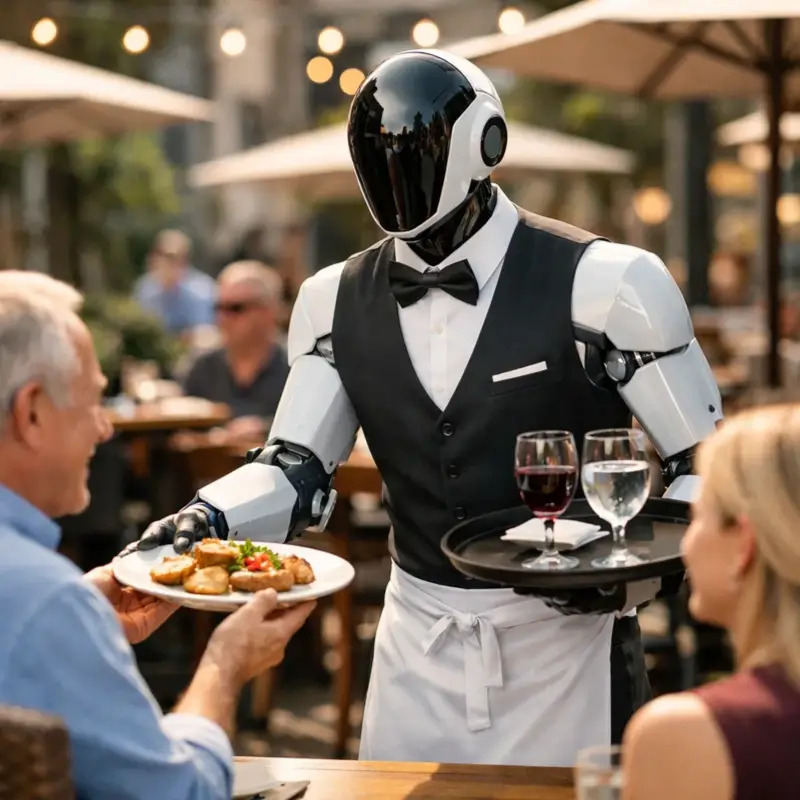
First, AI robots will need to learn how to handle countless situations. Photo illustration: © Xootle B.V.
Do Robots Need to Know Many Situations?
Yes, in order to act reliably, robot systems must be exposed to a wide range of situations, either through real-world experience or simulation. Unlike humans, robots aren't aware of their tasks. They navigate spaces of known and semi-known situations where learned actions lead to specific outcomes.
And don't be fooled by a robot's voice. Audio is usually just text-to-speech. It doesn't indicate any real understanding. It's output, not consciousness.
The real issue is that the media increasingly overlooks how results are achieved. This is a major impoverishment of society. Claiming that AI is intelligent demonstrates either a misunderstanding or an alternative agenda, such as appeasing advertisers and multinationals.
Media Madness
"Look, the robot does what I can, so it must be smart."
"Look, AI writes an article, so it must be smart."
Once again, wrong conclusions.
The robot isn't aware of its own actions. AI doesn't understand texts; it uses and builds on existing ones.
The correct conclusion is that they are all interesting techniques, but they are not intelligent.
How could it be?
The outcome could be different if intelligence were interpreted in a different way. Alternatively, we could distinguish between human and technical intelligence. However, the two should not be related, as they are entirely different fields.
Current terminologies relate to humans, which is problematic:
If you gather 500 of the most intelligent and versatile people from around the world, the energy they consume for food, drink and shelter would be negligible compared to the current energy needs of AI systems. In terms of content, these 500 people are collectively smarter, more flexible and more creative than existing and future AI systems, particularly when it comes to tasks beyond a narrow definition.
The real advantage of AI isn't human cleverness, but scale. Humans can't hold millions of conversations simultaneously, but AI can.
So: technique!
And don't be fooled by a robot's voice. Audio is usually just text-to-speech. It doesn't indicate any real understanding. It's output, not consciousness.
The real issue is that the media increasingly overlooks how results are achieved. This is a major impoverishment of society. Claiming that AI is intelligent demonstrates either a misunderstanding or an alternative agenda, such as appeasing advertisers and multinationals.
Media Madness
"Look, the robot does what I can, so it must be smart."
"Look, AI writes an article, so it must be smart."
Once again, wrong conclusions.
The robot isn't aware of its own actions. AI doesn't understand texts; it uses and builds on existing ones.
The correct conclusion is that they are all interesting techniques, but they are not intelligent.
How could it be?
The outcome could be different if intelligence were interpreted in a different way. Alternatively, we could distinguish between human and technical intelligence. However, the two should not be related, as they are entirely different fields.
Current terminologies relate to humans, which is problematic:
- ANI – Artificial Narrow Intelligence: excels at one or a limited number of tasks
- AGI – Artificial General Intelligence: can reason, learn, and apply knowledge across domains like a human
- ASI – Artificial Superintelligence: intelligence surpassing human capability
- ANI is purely technical: code and hardware control.
- AGI is mere software technique, sometimes yielding human-like results. It's essentially a vast knowledge base delivering rapid information.
- ASI might be possible once synthetic intelligence arises, akin to living organisms like our brains. Here, we're discussing sentient organisms, like the superintelligence of aliens. Aliens are organisms, not computer code like AI. Society's inability to handle aliens is another matter, involving significant interests from power blocs.
If you gather 500 of the most intelligent and versatile people from around the world, the energy they consume for food, drink and shelter would be negligible compared to the current energy needs of AI systems. In terms of content, these 500 people are collectively smarter, more flexible and more creative than existing and future AI systems, particularly when it comes to tasks beyond a narrow definition.
The real advantage of AI isn't human cleverness, but scale. Humans can't hold millions of conversations simultaneously, but AI can.
So: technique!
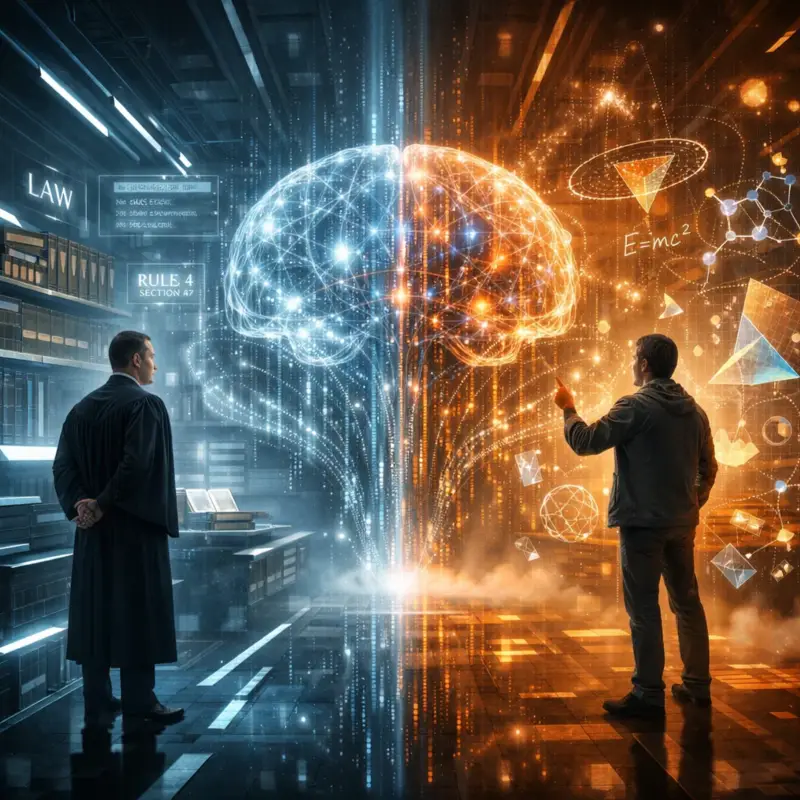
Learning, repeating, and executing versus understanding, comprehending, improving, and then executing. Photo illustration: © Xootle B.V.
Why Do People Think So Differently: Alpha and Beta
Understanding the following will shed light on many societal divides and the role of AI, as well as its dangers.
Consider the two cognitive approaches below:
What does the alpha thinker do?
It's more about loyalty to your employer or superior than using your intelligence for personal gain.
What does the beta thinker do?
An example:
If you have a 100 m² space and each person needs 10 m², then only 10 people can fit in it.
The alpha reaction:
The beta reaction:
It is immediately apparent why people talk past each other and live in different worlds: they use different benchmarks.
Conclusion: Why AI is a Fad.
Current AI is purely alpha and incorporates beta outcomes in its presentation.
Thus, AI seems smart, but is essentially just a parrot with a vast information base.
Consider the two cognitive approaches below:
- Alpha thinking involves accepting what you read, learning, executing, following rules, speed and discipline.
- Beta thinking involves questioning, modelling, reasoning, explaining and asking 'why?'.
What does the alpha thinker do?
- A judge may act on the basis of "it's in the law".
- A soldier or officer might say, "It's an order."
It's more about loyalty to your employer or superior than using your intelligence for personal gain.
What does the beta thinker do?
- An engineer designs based on facts and proven formulas, not opinions.
- A programmer crafts software based on mathematical formulas, not opinions.
An example:
If you have a 100 m² space and each person needs 10 m², then only 10 people can fit in it.
The alpha reaction:
- Based on learned texts (good and bad principles) and emotions.
- Learned: 'You should always share so that more people can fit.'
- There are no facts, just opinions.
- Thus, the alpha thinker says, 'I think more than ten people can fit, so we'll do it.'
The beta reaction:
- Based on facts and proven formulas, not speculation.
- The beta thinker calculates and reasons: 100 ÷ 10 = 10.
- Thus, a beta thinker states: 'Maximum 10 people, period.'
It is immediately apparent why people talk past each other and live in different worlds: they use different benchmarks.
Conclusion: Why AI is a Fad.
Current AI is purely alpha and incorporates beta outcomes in its presentation.
Thus, AI seems smart, but is essentially just a parrot with a vast information base.

Cold reading in action. Photo illustration: © Xootle B.V.
Is AI Actually AC (Artificial Cold Reading)?
Yes, AI is essentially a form of artificial cold reading.
You're probably familiar with TV shows featuring people claiming to have paranormal abilities, such as Peter Popoff, who was wholly discredited. However, the paranormal isn't the same as 'remote viewing', a practice that Uri Geller attempted with mixed success. Geller conducted remote viewing at SRI in Menlo Park, California. Geller combined tricks with genuine abilities. I've seen him bend spoons and spin an old compass (tricks). Remote viewing is a skill, not a trick. Combining tricks and skills made Uri Geller quite successful.
Cold Reading
Cold reading is the process of cleverly obtaining information from someone and then presenting it in a way that makes it appear as if it came from a paranormal source. It's essentially a con. The same applies to AI, albeit on a large scale. People supply AI systems with information and often retrieve their own information back, mixed with that of others. This is dubbed 'Artificial Intelligence'. 'Artificial Cold Reading' sounds less appealing.
You're probably familiar with TV shows featuring people claiming to have paranormal abilities, such as Peter Popoff, who was wholly discredited. However, the paranormal isn't the same as 'remote viewing', a practice that Uri Geller attempted with mixed success. Geller conducted remote viewing at SRI in Menlo Park, California. Geller combined tricks with genuine abilities. I've seen him bend spoons and spin an old compass (tricks). Remote viewing is a skill, not a trick. Combining tricks and skills made Uri Geller quite successful.
Cold Reading
Cold reading is the process of cleverly obtaining information from someone and then presenting it in a way that makes it appear as if it came from a paranormal source. It's essentially a con. The same applies to AI, albeit on a large scale. People supply AI systems with information and often retrieve their own information back, mixed with that of others. This is dubbed 'Artificial Intelligence'. 'Artificial Cold Reading' sounds less appealing.

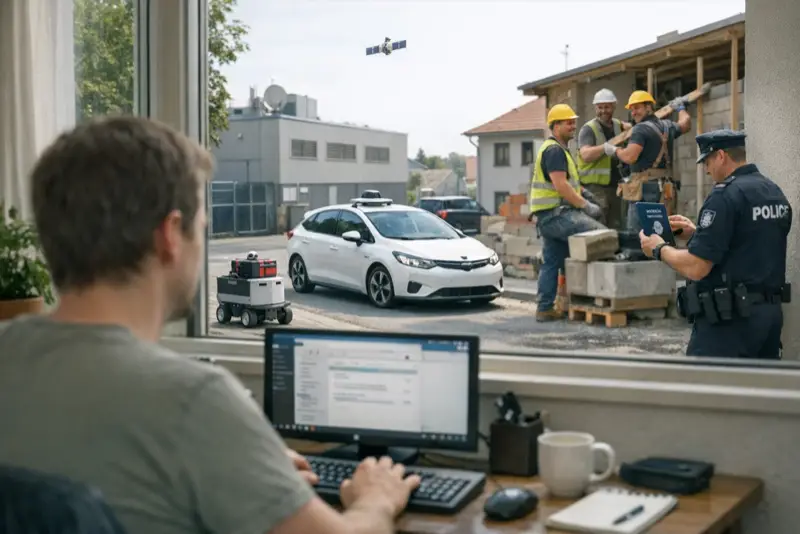
The exodus of managers and the glory of craftsmen. Photo illustration: © Xootle B.V.
The Future of Work: How AI Will Change Your Job
The world is changing rapidly with the rise of artificial intelligence (AI). This issue affects everyone, from office workers to construction site artisans. But what impact will this have on our daily activities? Let's explore roles under threat, roles that are more secure than ever before, and the new opportunities that are arising.
Jobs under pressure: Roles That Will Change
The roles most significantly impacted by AI are often described as 'alpha roles'. These involve language, data processing or fixed routines. Such tasks are often costly and repetitive, so AI will largely take over.
Administrative and legal routine tasks
Examples include the drafting of standard contracts, translating general texts, and preliminary research in dossiers. Positions such as clerks, basic translators and accounting assistants will increasingly be carried out by smart software and AI.
Middle management and controllers
Middle management positions in companies are at risk. Managers who are primarily responsible for summarising documents, preparing decisions for boards or controlling processes (such as speed monitors) are being outperformed by systems that can perform these tasks more quickly and without errors.
Entry-level creative production
It is becoming very challenging for junior software developers, budding illustrators, and models for figurative work. AI can now generate images or write basic code without human intervention.
The 'Safe Havens': Why Real Workers Triumph
The good news is that a substantial part of the job market remains strong. These are mostly 'beta jobs' and professions where human insight, physical skills or a real presence are crucial.
Craftsmen and artisans
While AI can achieve a lot, tasks such as plastering walls, fixing leaky pipes, and maintaining cars are beyond a computer's capabilities. Painters, carpenters, electricians and paving contractors needn't worry. Their physical dexterity and on-site problem-solving skills are irreplaceable.
Healthcare and hospitality
In healthcare and hospitality, people are at the heart of everything. While robots can assist with cleaning, performing surgeries and delivering coffee, genuine care remains a human task. In hotels and restaurants, AI will handle the paperwork, freeing up staff to focus on providing genuine customer service. So-called robot hotels have failed because people simply don't want them.
Public Sector and Decision-Making
Roles requiring a moral compass or authority will always be carried out by humans. Examples include judges, politicians, police officers and soldiers. Here, humans must decide, not algorithms.
New roles: The rise of the 'all-rounder'
AI not only eliminates jobs, but also creates an entirely new class of professionals. I am seeing a shift towards 'one-person teams' who are all-rounders.
The integrator
These individuals bridge gaps. They understand client needs, know how to direct AI to accomplish tasks and oversee product quality. They deliver results that would once have required an entire team.
The AI Director
In the creative sector, work shifts from 'doing it yourself' to 'directing'. Future designers will use the right instructions (prompts) to guide AI and maintain a company's style and brand.
Strategic Advisors
Lawyers and accountants won't disappear, but their roles will change. They will use AI for quick calculations and research, focusing instead on providing complex advice, negotiating and engaging in human interactions.
Conclusion: A New Balance
The coming years will clarify which work truly holds value. Jobs centred on repetition, control, passing information and meetings will come under increasing pressure. Only roles that genuinely add value will remain. Those who can create, solve problems, demonstrate understanding or innovate are more important than ever. Whether they work with their hands, with people, or with systems, the future favours those who can truly add something special. AI is not a supplement to everything, but an aid. Creativity, practical skills, and technical insight set us apart from the past 40 years.
Jobs under pressure: Roles That Will Change
The roles most significantly impacted by AI are often described as 'alpha roles'. These involve language, data processing or fixed routines. Such tasks are often costly and repetitive, so AI will largely take over.
Administrative and legal routine tasks
Examples include the drafting of standard contracts, translating general texts, and preliminary research in dossiers. Positions such as clerks, basic translators and accounting assistants will increasingly be carried out by smart software and AI.
Middle management and controllers
Middle management positions in companies are at risk. Managers who are primarily responsible for summarising documents, preparing decisions for boards or controlling processes (such as speed monitors) are being outperformed by systems that can perform these tasks more quickly and without errors.
Entry-level creative production
It is becoming very challenging for junior software developers, budding illustrators, and models for figurative work. AI can now generate images or write basic code without human intervention.
The 'Safe Havens': Why Real Workers Triumph
The good news is that a substantial part of the job market remains strong. These are mostly 'beta jobs' and professions where human insight, physical skills or a real presence are crucial.
Craftsmen and artisans
While AI can achieve a lot, tasks such as plastering walls, fixing leaky pipes, and maintaining cars are beyond a computer's capabilities. Painters, carpenters, electricians and paving contractors needn't worry. Their physical dexterity and on-site problem-solving skills are irreplaceable.
Healthcare and hospitality
In healthcare and hospitality, people are at the heart of everything. While robots can assist with cleaning, performing surgeries and delivering coffee, genuine care remains a human task. In hotels and restaurants, AI will handle the paperwork, freeing up staff to focus on providing genuine customer service. So-called robot hotels have failed because people simply don't want them.
Public Sector and Decision-Making
Roles requiring a moral compass or authority will always be carried out by humans. Examples include judges, politicians, police officers and soldiers. Here, humans must decide, not algorithms.
New roles: The rise of the 'all-rounder'
AI not only eliminates jobs, but also creates an entirely new class of professionals. I am seeing a shift towards 'one-person teams' who are all-rounders.
The integrator
These individuals bridge gaps. They understand client needs, know how to direct AI to accomplish tasks and oversee product quality. They deliver results that would once have required an entire team.
The AI Director
In the creative sector, work shifts from 'doing it yourself' to 'directing'. Future designers will use the right instructions (prompts) to guide AI and maintain a company's style and brand.
Strategic Advisors
Lawyers and accountants won't disappear, but their roles will change. They will use AI for quick calculations and research, focusing instead on providing complex advice, negotiating and engaging in human interactions.
Conclusion: A New Balance
The coming years will clarify which work truly holds value. Jobs centred on repetition, control, passing information and meetings will come under increasing pressure. Only roles that genuinely add value will remain. Those who can create, solve problems, demonstrate understanding or innovate are more important than ever. Whether they work with their hands, with people, or with systems, the future favours those who can truly add something special. AI is not a supplement to everything, but an aid. Creativity, practical skills, and technical insight set us apart from the past 40 years.

Will an internet passport be the future?
What Is Raymond Girbes' Vision for the Future of AI?
The current AI bubble is set to burst between 2026 and 2027. This means that large data centres will be found to be unnecessary on a large scale, causing many AI providers to go bankrupt. While cloud AI will undoubtedly persist, it won't be on the scale that AI leaders proclaim. For businesses and governments, cloud AI will supplement centralisation efforts. However, home users and SMEs will mostly use LLM models and their successors locally on their own computers and networks. Occasionally, additional AI data from the cloud might be accessed via an API key. Computers have become powerful enough to easily and safely handle the minimal AI requirements on your own PC.
Alternatively, you could trade all your privacy for AI prompts with advertising giants like Facebook, Instagram and Google.
AI via traditional CPUs, not costly GPU cards
The first LLM models that can be used on a regular PC are already here. Finally, something good from Microsoft: Bitnet, which is open source with an MIT licence. It's an AI model that consumes far less energy and can run on a standard PC.
Synergy
A fusion of existing software, AI agents and AI databases containing texts, mathematics, videos and audio is on the horizon. Robots will become affordable and practical. Autonomous driving will be partially successful thanks to AI, expansive digital beacons and ground infrastructure powered by 5G and satellite connections such as Starlink.
Political fools!
If naive politicians succeed in stripping citizens of their last shred of freedom, a small group will dictate the future of AI. I foresaw this happening in 1996 when I started out as an internet pioneer on the island of Texel with the domain texel.com, which now serves as a redirect.
Internet Passport
In 2002, I registered the domain internetpassport.net. It was clear to me then that a parliamentary democracy equates to an autocratic state, polished by the media. They want to know everything about you and make decisions on your behalf. Soon, you'll need an internet passport or whatever they choose to call it, such as DigiD, EUROID or eHerkenning, to legally access the internet. It's a shame that the government distrusts its citizens when it is hardworking citizens and entrepreneurs who sustain the government and pay their salaries. If an internet passport becomes the only legal way to access the internet, it will dramatically alter the way we interact with AI.
Alternatively, you could trade all your privacy for AI prompts with advertising giants like Facebook, Instagram and Google.
AI via traditional CPUs, not costly GPU cards
The first LLM models that can be used on a regular PC are already here. Finally, something good from Microsoft: Bitnet, which is open source with an MIT licence. It's an AI model that consumes far less energy and can run on a standard PC.
Synergy
A fusion of existing software, AI agents and AI databases containing texts, mathematics, videos and audio is on the horizon. Robots will become affordable and practical. Autonomous driving will be partially successful thanks to AI, expansive digital beacons and ground infrastructure powered by 5G and satellite connections such as Starlink.
Political fools!
If naive politicians succeed in stripping citizens of their last shred of freedom, a small group will dictate the future of AI. I foresaw this happening in 1996 when I started out as an internet pioneer on the island of Texel with the domain texel.com, which now serves as a redirect.
Internet Passport
In 2002, I registered the domain internetpassport.net. It was clear to me then that a parliamentary democracy equates to an autocratic state, polished by the media. They want to know everything about you and make decisions on your behalf. Soon, you'll need an internet passport or whatever they choose to call it, such as DigiD, EUROID or eHerkenning, to legally access the internet. It's a shame that the government distrusts its citizens when it is hardworking citizens and entrepreneurs who sustain the government and pay their salaries. If an internet passport becomes the only legal way to access the internet, it will dramatically alter the way we interact with AI.
Finally!
Humour?
Perhaps the parrot was the first form of AI.
Now, it's just a notch more advanced.
Now, it's just a notch more advanced.
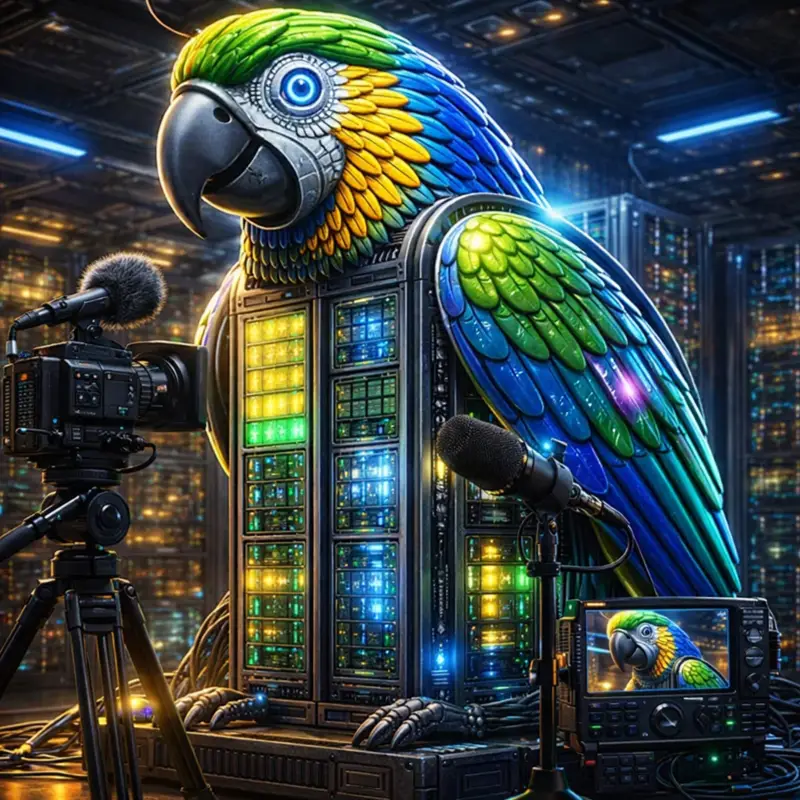
Intelligence or parrot? Photo illustration: © Xootle B.V.
FAQ about AI
Do we use AI?
Absolutely, AI is a fantastic tool for text, ideas, translations, programming, photos, and videos. It will gradually improve but won't necessarily become much more intelligent. And it doesn't have to, as AI can already accomplish an impressive amount.
Is AI reliable?
No, as of March 2026, AI isn't reliable, and here are five reasons why:
- AI often malfunctions (hallucinations).
- AI can treat inaccurate information as accurate.
- AI isn't intelligent.
- AI cannot perceive, smell, experience, or feel emotions like a human.
- AI is merely a computer.
Is AI amazing?
Yes, AI is an amazing tool if used correctly. It can save a lot of time and elevate your work performance.
I want to know what AI can do for my business
That's possible. A bit of self-promotion! Call me. For only 2 euros per minute, you can receive all the information you need. You control the call duration: +31 85 760 4280. You'll receive an invoice.